
A 2005 Rayquaza Pokemon card from EX Emerald has reached an astonishing $384,000 at auction, highlighting just how much collectors are willing to spend on exceptionally rare, high-grade cards from Pokemon’s EX era.
The Reverse Holo Rayquaza #9, graded PSA 10 Gem Mint, closed through Fanatics Collect on November 2, 2026. The result is particularly surprising because another PSA 10 example of the same card sold for just $3,720 in June 2024.
That represents a price difference of more than 100 times in less than two and a half years. While the two sales involved different copies, the comparison shows how dramatically the market for certain older Pokemon cards has changed.
The card’s rarity in perfect condition helps explain the attention. According to PSA population data cited in the auction listing, only five copies of this particular Reverse Holo Rayquaza have received a PSA 10 grade.
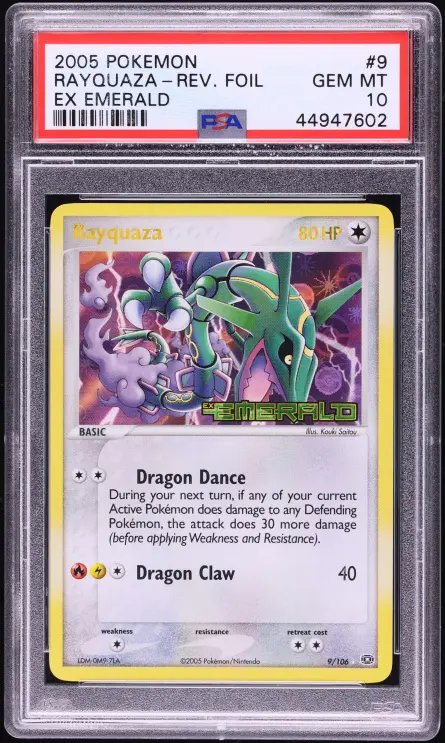
A $384,000 Sale for a Card From EX Emerald
The auction took place during Fanatics Collect’s 250th Weekly Sunday Auction, which featured thousands of collectibles across multiple categories. The Rayquaza card was listed as a 2005 Pokemon EX Emerald Reverse Holo #9, with PSA certification number 44947602.
The auction recorded a final price of $384,000, including the buyer’s premium.
For collectors unfamiliar with EX Emerald, the expansion arrived in 2005 during the Pokemon TCG’s EX era. It featured several popular Pokemon, including Rayquaza, alongside the distinctive Reverse Holo treatments used throughout that period.
Unlike modern illustration rares or special illustration rares, this Rayquaza does not rely on elaborate full-card artwork to attract collectors. Its value comes from a combination of the Pokemon itself, the age of the card, its condition, and the difficulty of finding a pristine example.
Reverse Holo cards from this period can be particularly challenging to grade. Surface scratches, edge wear, printing imperfections, and damage accumulated over two decades can prevent otherwise attractive cards from receiving a perfect grade.
That makes the five-copy PSA 10 population an important part of this result. The card is not necessarily impossible to find in lower grades, but finding one that meets PSA’s Gem Mint standard is an entirely different challenge.
From $3,720 in 2024 to $384,000 in 2026
The most striking comparison comes from the card’s earlier auction history.
Market records show that a PSA 10 Reverse Holo Rayquaza from EX Emerald sold through Fanatics Collect for $3,720 on June 2, 2024.
The November 2026 result is approximately 103 times that earlier sale.
| Sale detail | June 2024 | November 2026 |
|---|---|---|
| Card | EX Emerald Rayquaza #9 Reverse Holo | EX Emerald Rayquaza #9 Reverse Holo |
| Grade | PSA 10 | PSA 10 |
| Recorded price | $3,720 | $384,000 |
| Auction platform | Fanatics Collect | Fanatics Collect |
| Difference | — | +10,223% |
The percentage is extraordinary, but it needs context.
These were not sales of the exact same physical card, and two transactions alone cannot establish a reliable market price for every PSA 10 copy. When a card has a population this small, a single determined bidder can have an enormous influence on the final auction result.
There is also a difference between an auction closing at a particular price and a transaction being fully paid and completed. Fanatics has published the $384,000 result, but payment completion has not been independently confirmed.
Even with those limitations, the difference between the two recorded auction prices is difficult to ignore.
Why PSA 10 Condition Matters So Much
The Rayquaza sale is another example of how condition rarity can become more important than the overall scarcity of a Pokemon card.
Collectors can find copies of EX Emerald Rayquaza in other conditions, and those cards do not necessarily command anything close to the latest auction result.
The five-copy PSA 10 population creates a very different market. A collector specifically pursuing the highest-grade example may have few opportunities to purchase one, particularly if existing owners have no interest in selling.
That scarcity can produce aggressive bidding whenever a desirable copy becomes available.
The EX era also occupies an interesting position in Pokemon collecting. These cards are old enough to have survived years of handling, storage, and collecting habits that were very different from today’s market. Many collectors who opened these packs in the mid-2000s were not immediately placing every valuable card into protective sleeves or submitting them for grading.
As a result, some cards that were relatively accessible when released have become exceptionally difficult to find in pristine condition.
Rayquaza adds another layer of demand. The Legendary Pokemon has remained a collector favorite across multiple generations, with cards from EX Deoxys, EX Dragon, and other older expansions attracting considerable attention.
Still, popularity alone cannot explain a $384,000 result. The unusually small population of this particular card is central to understanding its auction performance.
What This Sale Says About the Pokemon Card Market
The timing comes as Pokemon prepares to release Mega Evolution—Delta Reign on November 6, bringing Mega Rayquaza ex back into the spotlight.
That connection makes the auction especially interesting, although there is no evidence that the upcoming expansion directly caused the six-figure result.
A stronger explanation lies in the growing competition for exceptionally graded cards from older Pokemon sets.
Modern chase cards can experience substantial price swings as additional products enter circulation and more copies receive high grades. Older cards with extremely small PSA 10 populations operate differently because their supply is much more limited.
That does not mean every vintage or mid-era Pokemon card will appreciate. It also does not mean the next PSA 10 EX Emerald Rayquaza will sell for $384,000.
A record-setting auction can reflect an unusually competitive group of bidders rather than a price that the broader market would consistently support.
Collectors should also distinguish between the different versions of Rayquaza #9 from EX Emerald. The standard Holo and Reverse Holo printings have different grading populations and sales histories. Comparing their prices without identifying the exact version can create a misleading impression of the card’s value.
For anyone tracking the market, the important question is whether future sales of similarly graded copies support this result or fall substantially below it.
A Remarkable Result, but Not a Guaranteed New Market Price
The $384,000 auction result places this EX Emerald Rayquaza among the most expensive Pokemon cards to appear in recent sales reporting.
Its price is remarkable for a card that lacks the usual characteristics associated with the hobby’s biggest sales, such as a First Edition Base Set Charizard, a Gold Star designation, or an exclusive tournament distribution.
Instead, it demonstrates how an ordinary expansion card can become extraordinarily valuable when the combination of condition, popularity, and surviving supply is difficult to replicate.
The jump from $3,720 in 2024 to $384,000 in 2026 is one of the most dramatic comparisons involving a high-grade EX-era Pokemon card.
Whether the latest auction establishes a lasting price level remains to be seen. For now, it provides another striking example of how much collectors may pay for one of the few surviving Gem Mint copies of a desirable older Pokemon card.