
The same Base Set Charizard was printed three different ways in 1999, and the three sell for wildly different money. A 1st Edition copy in PSA 10 has sold for over $300,000. The Unlimited version in the same grade is a few thousand. The cards look nearly identical at arm’s length, so this is the first thing to check on any Base Set card, and the thing fakes and resellers most often get wrong.
The three printings, in the order they were made
1st Edition. The first print run, also known as the Base Set, from January 1999. Every card has a small black “Edition 1” stamp on the left side of the card, just below the artwork box. On Pokemon cards it sits to the left of the attack text; on trainers and energies it is in the same place relative to the picture. If the stamp is there, it is 1st Edition. These are the scarcest and the most valuable.
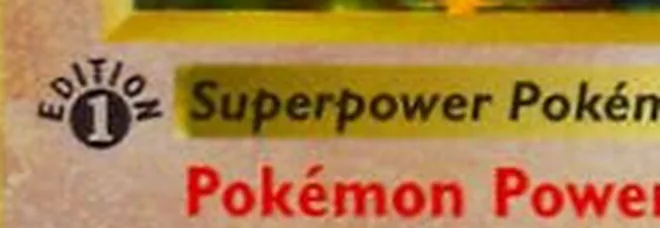
Shadowless. The second run, printed after the 1st Edition stamp was dropped but before the card design was changed. Same plates, no stamp. Shadowless cards exist only for Base Set; Jungle and Fossil went straight from 1st Edition to the later design.
Unlimited. Everything after that, which is the vast majority of Base Set in circulation. The print run went on for over a year and then Base Set 2 reprinted most of it again in 2000.
How to tell Shadowless from Unlimited
The name says it. On an Unlimited card the artwork box has a drop shadow along its right and bottom edges, a thin grey line that makes the picture look raised. On a Shadowless card there is no shadow; the box is flat against the yellow border. Hold two cards side by side and it is obvious. On one card alone, look at the right edge of the picture frame. Flat means Shadowless.
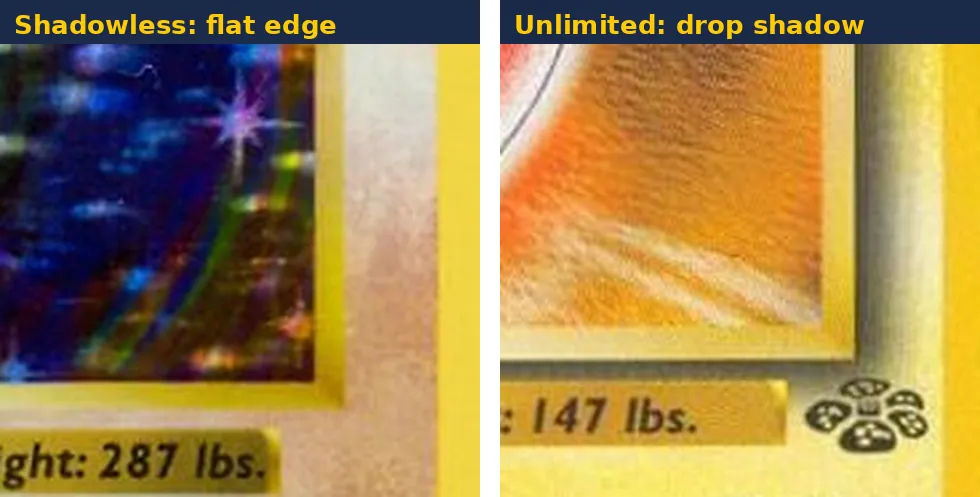
There are two more tells if the shadow is hard to read on a worn card. The HP on a Shadowless card is printed in a thinner red typeface; on Unlimited it is bold and heavier. And the copyright line at the bottom of a Shadowless card reads “1995, 96, 98, 99 Nintendo, Creatures, GAMEFREAK” with 1999 included; later Unlimited runs dropped the 99.
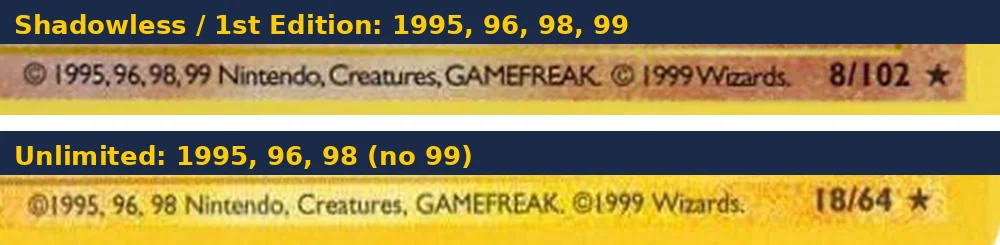
A 1st Edition Base Set card is always Shadowless as well, because the stamp came off before the shadow went on. So a card with the stamp and the shadow together is not a real 1st Edition Base Set card.
What it does to the price
Take Base Set Charizard #4 as the example because it has the most sales to compare. On our data, raw Near Mint copies run roughly: Unlimited a few hundred dollars, Shadowless several times that, 1st Edition into five figures. Graded, the gap widens further because the population of high-grade 1st Edition cards is tiny. The exact numbers move; the set pages carry today’s figures and the card pages show what PSA 10 copies have actually sold for on eBay in the last 90 days.
Jungle and Fossil
Jungle and Fossil both have 1st Edition and Unlimited printings, and no Shadowless. The stamp check is the same. Jungle has one extra wrinkle: some 1st Edition holos were printed without the Jungle set symbol, an error that collectors pay a premium for. Fossil’s 1st Edition stamp is in the same spot as Base Set.
After Fossil the stamp continued through Team Rocket, the Gym sets and the Neo series, and ended with Neo Destiny in 2002. Nothing printed after that has a 1st Edition stamp, so a modern card claiming to be 1st Edition is not.
Quick check
- Stamp on the left under the art? 1st Edition.
- No stamp, no shadow on the picture box? Shadowless. Base Set only.
- No stamp, shadow present? Unlimited.
If you are not sure, the scanner can tell Shadowless from Unlimited on most cards because the layouts differ, and the condition guide covers what wear does to each of these.