
Goldin’s Pokemon 30th Anniversary Auction delivered one of the biggest nights in Pokemon card collecting history, with more than $28 million in sales and several rare cards reaching seven-figure prices. A 2015 Art Academy Mudkip led the auction at $4.88 million, while a Gold Trophy Pikachu from Japan’s first official Pokemon tournament sold for more than $3 million.
The results went well beyond the two headline cards. Art Academy Sableye and Gourgeist each reached $976,000, a Gold Star Umbreon sold for $738,100, and several vintage Pokemon cards cleared half a million dollars.
Goldin confirmed that the event exceeded $28 million, surpassing its previous trading card auction total record. A separate auction tracker reported approximately $29.5 million across 546 Pokemon lots sold during the week ending October 26. That weekly figure includes other Goldin auctions, so it should not be treated as the anniversary auction’s standalone total.
The sale highlighted how much collectors are willing to pay for Pokemon cards with exceptional rarity, unusual origins, and historical importance. It also showed that the highest prices are no longer reserved for Charizard and Pikachu.
Art Academy Mudkip Leads the Auction at $4.88 Million
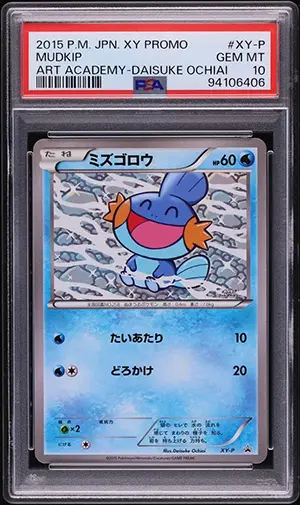
The biggest sale was a Japanese Art Academy Mudkip illustrated by Daisuke Ochiai, which sold for $4,880,000 including buyer’s premium. The PSA 10 card attracted 73 bids before closing at a $4 million hammer price.
The card originated from the 2015 Pokemon Art Academy illustration competition, which allowed artists to create original Pokemon artwork. Winning designs were produced as promotional cards, with each artist receiving a limited number of copies.
Goldin identified just three PSA 10 examples of the Mudkip card, making it one of the most difficult Pokemon collectibles to acquire in top condition.
The October result also represents a substantial increase from September, when another PSA 10 Art Academy Mudkip sold through Fanatics Collect for $3.72 million. The latest sale exceeded that figure by $1.16 million, or approximately 31%.
Art Academy cards have become a major category within the high-end Pokemon market because of their limited distribution and distinctive artwork. Unlike conventional chase cards, these were not available in booster packs or retail products.
Two additional Art Academy cards reinforced that demand during the same auction. A PSA 10 Sableye illustrated by Iwaiya sold for $976,000, while a PSA 10 Gourgeist illustrated by Rina matched that price.
Historic Trophy Pikachu Reaches $3.08 Million
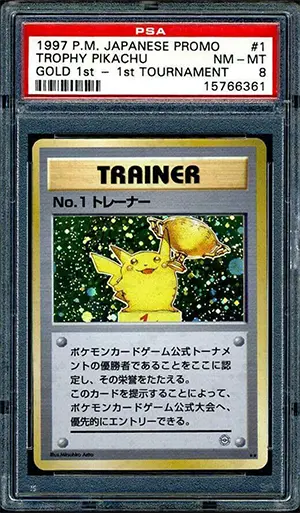
A 1997 Japanese Gold First Place Trophy Pikachu sold for $3,080,500, setting a new publicly reported high for a Trophy Pikachu card.
Graded PSA 8, the card was awarded in connection with Japan’s first official Pokemon TCG tournament in June 1997. Its artwork, created by Mitsuhiro Arita, depicts Pikachu standing on a podium and holding a trophy.
These early tournament prizes occupy a special place in Pokemon collecting. They were distributed to competitors rather than sold to the public, and surviving examples represent an important part of the trading card game’s earliest history.
The latest sale was particularly notable because the card achieved its record price without receiving a Gem Mint 10 grade. Its historical significance and scarcity were evidently enough to attract substantial competition.
Goldin reported the result as the highest public sale for any Trophy Pikachu. The final price included a 22% buyer’s premium, with the winning bid itself reaching $2,525,000.
The 10 Biggest Pokemon Card Sales
The following prices are completed auction results reported for Goldin’s Pokemon 30th Anniversary Auction. All figures include buyer’s premium.
| Pokemon card | Grade | Sale price |
|---|---|---|
| 2015 Art Academy Mudkip | PSA 10 | $4,880,000 |
| 1997 Gold Trophy Pikachu | PSA 8 | $3,080,500 |
| 2015 Art Academy Sableye | PSA 10 | $976,000 |
| 2015 Art Academy Gourgeist | PSA 10 | $976,000 |
| 2007 Gold Star Umbreon | PSA 10 | $738,100 |
| 2004 Gold Star Mudkip | PSA 10 | $610,000 |
| 1996 No Rarity Mewtwo | PSA 10 | $603,900 |
| 2007 Gold Star Espeon | PSA 10 | $573,400 |
| 2002 Legendary Collection Pikachu | PSA 10 | $481,900 |
| 2002 Legendary Collection Charizard | PSA 10 | $463,600 |
These ten cards alone generated approximately $13.38 million in reported auction prices.
Gold Star Umbreon and Espeon Attract Major Bids
Gold Star cards were another major attraction. A PSA 10 Umbreon from the 2007 POP Series 5 release sold for $738,100, while a PSA 10 Espeon from the same series reached $573,400.
Together, the two Eeveelution cards brought $1,311,500.
Both cards originated from promotional packs distributed through the Pokemon Organized Play program, rather than ordinary booster sets. Their limited availability, combined with the popularity of Umbreon and Espeon, has made high-grade examples especially desirable.
A PSA 10 Gold Star Mudkip from EX Team Rocket Returns also sold for $610,000. That result was impressive on its own, although it was below the $1.02 million reported for another PSA 10 example in September.
The difference illustrates an important point about rare Pokemon cards: even when two examples share the same grade, auction results can vary considerably depending on the bidders, timing, and individual cards involved.
Vintage Pokemon Cards Remain Strong
Not every major result involved an obscure promotional release. Several recognizable vintage cards also commanded extraordinary prices.
A 1996 Japanese Base Set No Rarity Symbol Mewtwo, graded PSA 10, sold for $603,900. No Rarity Symbol cards are associated with the earliest Japanese Base Set printings and are distinguished by the absence of the rarity symbol found on later versions.
Meanwhile, two reverse holographic cards from the 2002 Legendary Collection produced substantial results. A PSA 10 Pikachu reached $481,900, while a PSA 10 Charizard sold for $463,600.
Legendary Collection cards are recognizable for their distinctive fireworks-style reverse holographic pattern. Their surfaces are also highly sensitive to visible wear, making exceptionally clean copies difficult to find.
These results demonstrate that demand for high-grade vintage cards extends beyond the traditional 1999 First Edition Base Set.
What the Auction Means for the Pokemon Card Market
Goldin’s auction demonstrated the enormous amount of money competing for Pokemon’s rarest collectibles, but it would be a mistake to interpret the results as evidence that every Pokemon card is increasing in value.
Most of the auction’s biggest sales involved cards with unusually limited distribution, extremely small grading populations, or direct connections to Pokemon history. Those characteristics separate them from the modern singles and sealed products traded by most collectors.
The results also revealed how volatile the high-end market can be. Art Academy Mudkip climbed from $3.72 million in September to $4.88 million in October, while Gold Star Mudkip produced a lower result than another PSA 10 example sold the previous month.
At this level, individual buyers can have an enormous influence on the final price. A record sale establishes what someone was willing to bid in that particular auction, not necessarily what every other example would command.
Still, the scale of Goldin’s event is difficult to ignore. Cards that once occupied relatively obscure corners of the hobby are now generating prices associated with major fine art and historical collectibles.
For Pokemon collectors, the biggest takeaway is that scarcity and historical significance are increasingly important at the top of the market. Charizard remains an iconic collectible, but this auction belonged to Mudkip, Trophy Pikachu, and a group of rare promotional cards that most collectors will never encounter in person.