
Gold Star Rayquaza has officially crossed the million dollar mark. A 2005 Pokemon EX Deoxys Holo Rayquaza Gold Star #107 graded CGC Pristine 10 sold for $1.02 million in the August Fanatics Collect Premier Auction, becoming the first English language Pokemon card to sell for more than $1 million at public auction.
It is an enormous result for a card that was already considered one of the best chases of the EX era, but the headline needs some context. This sale does not necessarily mean Gold Star Rayquaza is now a million dollar card. It means one very specific copy was worth $1.02 million to the collectors bidding on it.
The difference is the grade. There are other Gold Star Rayquaza cards, including other copies in extremely high grades, but this is currently the only CGC Pristine 10. At this end of the Pokemon market, that population of one can matter as much as the card itself.
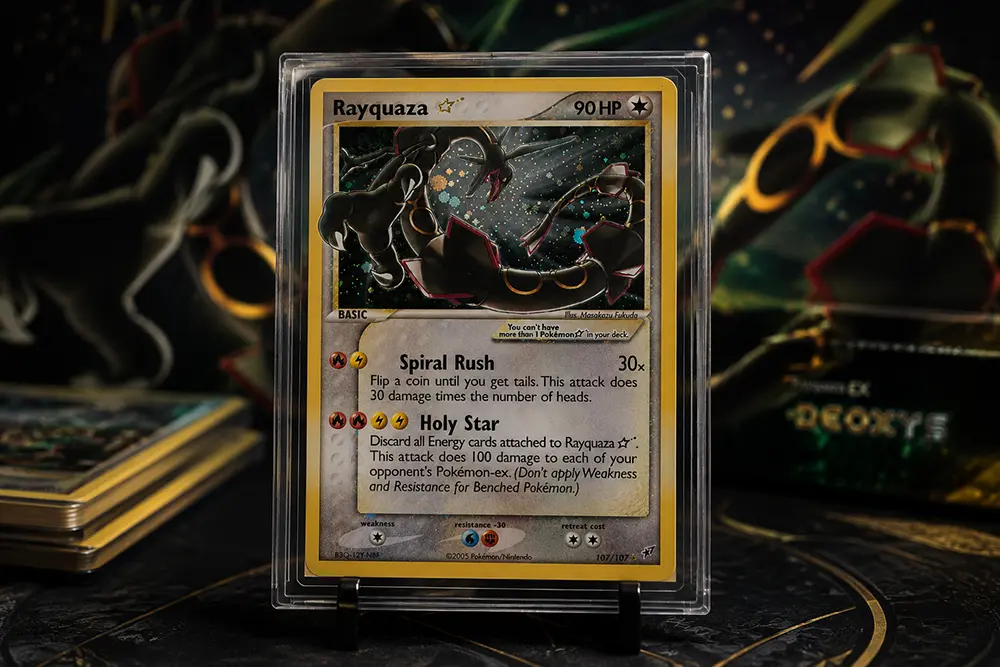
There Are Other Gold Star Rayquazas, but Only One Pristine 10
Gold Star Rayquaza was already difficult to find long before this auction. The card was released in EX Deoxys in 2005, when Gold Stars were among the hardest cards in the TCG to pull. More than 20 years of handling, binder storage and normal wear have made truly high grade copies considerably harder to find.
That is what separates vintage condition scarcity from the type of scarcity we usually see immediately after a modern release. A new chase card can look extremely scarce during its first few months because relatively few copies have reached grading companies. As more packs are opened and more submissions return, that population can increase quickly.
Rayquaza is different. The card has already had more than two decades for copies to enter the market and grading population. CGC has graded hundreds of examples, yet this is still the only copy to receive a Pristine 10. More high grade copies can always surface, but the potential supply is naturally limited because Pokemon cannot create more 2005 copies.
That makes the top of the population especially important. Someone who simply wants a Gold Star Rayquaza has plenty of grades to choose from. Someone who wants the highest graded CGC example currently has one.
The Difference Between Gem Mint and Pristine Was More Than $800,000
We do not have to guess how much the market valued the grade because another recent sale gives us a useful comparison. A CGC Gem Mint 10 Gold Star Rayquaza sold for $168,000 in July. Barely more than a month later, the Pristine 10 reached $1.02 million.
The Pokemon, set, card number and artwork are identical. What changed was the condition grade and, more importantly, the position that grade occupies within the population. The Pristine copy sold for more than six times as much as the Gem Mint example.
Normally, I would be cautious about paying an enormous multiple for a small difference at the top of a grading scale. Once you reach this level of the market, however, collectors are not necessarily making the same calculation as someone deciding between a PSA 9 and PSA 10 modern chase card.
They are buying exclusivity. A Gem Mint 10 is an exceptional copy of Gold Star Rayquaza, but another collector can buy one if another example reaches the market. The Pristine 10 currently represents something different because nobody else can own another copy at that grade.
That does not make the $1.02 million price automatically sustainable. It explains why normal comparisons become less useful when a card reaches population one territory.
This Is Condition Scarcity, Not Just Card Scarcity
We spend a lot of time looking at grading populations on Pokeforecast because population growth can completely change the way an expensive card should be valued. This has been especially important with new cards such as Mega Darkrai ex, where the earliest PSA 10 prices were established while very few graded copies existed.
Modern cards have an enormous supply pipeline behind them. Packs are still being opened, thousands of raw copies may be sitting in collections and large numbers of cards can arrive at PSA or CGC over the following year. A population of 50 shortly after release can eventually become a population of 5,000.
Vintage cards work differently. There are certainly still ungraded Gold Star Rayquazas in collections, and unopened EX Deoxys packs still exist, but the available pool is much more established. More importantly, every raw copy has already survived more than two decades. Finding another copy capable of reaching the very top of the grading scale becomes increasingly difficult.
That is why condition can become its own form of scarcity. Gold Star Rayquaza is rare regardless of grade, but a Pristine 10 takes an already scarce card and adds another layer that is considerably harder to reproduce.
The $1 Million Sale Does Not Make Every Gold Star Rayquaza More Valuable
Record sales tend to pull the rest of a card’s market upward, at least temporarily. Sellers see the headline, adjust their asking prices and start using the record as evidence that their own copies should be worth more. That will almost certainly happen with Gold Star Rayquaza.
There may be some justification for it. A seven figure sale puts enormous attention on the card, and some collectors who cannot afford the Pristine 10 may start looking at lower grades instead. Increased attention can create real demand throughout the population.
The mistake would be assuming every grade should move proportionally with the record. A collector spending $1.02 million for the only Pristine 10 is participating in a very different market from someone buying a PSA 7 or PSA 8. The lower graded copy provides access to Gold Star Rayquaza, while the Pristine 10 provides access to something that currently exists once.
That means I would be careful using this sale as a direct comp for other grades. It is evidence that the very top of the Rayquaza market is stronger than ever, but it is not a new price guide for every Gold Star Rayquaza.
Rayquaza Is Becoming One of Pokemon’s Most Important Collector Characters
The sale also reinforces something that has been developing for years. Rayquaza now belongs in the highest tier of Pokemon when it comes to collector demand.
Charizard still has the deepest history at the top of the hobby, while Pikachu has trophy cards that operate in their own part of the market. Umbreon has become one of the strongest characters in modern collecting. Rayquaza has built its market differently because it has desirable cards spread across several generations.
Gold Star Rayquaza is one of the defining cards of the EX era. Older Rayquaza EX and Mega Rayquaza cards remain collectible, while Rayquaza VMAX Alternate Art became one of the biggest chases of Sword & Shield. The current Mega Evolution era is now putting Rayquaza back in front of collectors again.
Delta Reign will feature Mega Rayquaza when the English expansion releases in November, and Pokemon has already previewed another Mega Rayquaza Mega Attack Rare. None of those announcements should be treated as the cause of this million dollar sale, but they do show how consistently Rayquaza remains relevant across different generations of the TCG.
That long term visibility is valuable. New collectors can discover Rayquaza through current products and eventually work backward into older cards, creating demand that does not depend entirely on nostalgia from collectors who were opening EX Deoxys in 2005.
New Rayquaza Cards Can Actually Strengthen the Older Market
Normally, repeated premium cards create some concern about collector saturation. If Pokemon releases several expensive versions of the same character within a short period, those cards can begin competing for the same collector money.
Rayquaza has historically handled that problem better than most Pokemon. Collectors have supported Gold Star Rayquaza, Rayquaza VMAX, older EX cards, Mega Rayquaza cards and numerous other releases without requiring one card to replace all of the others.
Part of that comes from the age differences between the cards. Someone buying a modern Mega Rayquaza is participating in a very different price range from someone buying the Gold Star. The modern card can actually become an entry point rather than a direct competitor.
A collector might start with a Delta Reign Mega Rayquaza, move into Rayquaza VMAX and eventually begin looking at older EX era cards. Very few will end up buying a million dollar Pristine 10, but they do not need to for the broader Rayquaza market to benefit.
This is one reason character demand matters so much when forecasting Pokemon cards. Strong characters can support a ladder of collectibles at different prices rather than relying on one chase card to carry the entire market.
A Population of One Does Not Have a Normal Market Price
The $1.02 million result is real, but I would still be careful calling it the established value of the card. A population one card does not trade frequently enough to have the type of market price we can assign to a liquid modern single.
What we know is that one copy became available and multiple collectors competed for it until the auction reached $1.02 million. That gives us an extremely important data point, but the next auction would still be another price discovery event.
If another CGC Pristine 10 appears, it could sell for more. It could also sell for considerably less. The existence of a second copy would itself change the scarcity argument because the buyer would no longer be purchasing the only one.
That uncertainty is normal at the highest end of collectibles. When supply becomes this small, the financial situation and motivation of a handful of buyers can matter more than broader market trends.
It is one of the reasons I would separate record auction results from normal card pricing. They tell us where the ceiling has moved, but they do not always tell us where the rest of the market should trade.
What I Would Watch From Here
The CGC population is the first thing I would monitor. As long as this remains the only Pristine 10, the card retains the exact characteristic that helped make this auction exceptional. A second Pristine copy would give us the first opportunity to see how much of the $1.02 million premium came specifically from being unique.
The next thing to watch is the rest of the Gold Star Rayquaza market. If Gem Mint and lower graded copies begin producing consistently stronger sales over the next several months, that would suggest the record auction created broader demand rather than simply producing one extraordinary transaction.
I would also watch older Rayquaza cards more generally as Delta Reign approaches. Rayquaza is about to receive another wave of attention from modern collectors, and that can sometimes send buyers backward through a character’s history. If older EX and Mega Rayquaza cards begin moving alongside the new releases, it would be a much stronger signal that demand for the character itself is expanding.
My Read on the $1 Million Rayquaza
Gold Star Rayquaza deserves its position as one of the most important Pokemon cards of the 2000s, and this sale confirms that the highest end of its market has moved into territory previously reserved for a very small group of English Pokemon cards.
I still would not describe Gold Star Rayquaza broadly as a million dollar card. The better way to understand the sale is that one of Pokemon’s most desirable vintage cards combined with an exceptional grade, a population of one and enough competition between high end collectors to produce a $1.02 million result.
That distinction is important because it explains why another Gold Star Rayquaza can sell for a fraction of the price without contradicting this auction. The market was not only valuing the card. It was valuing the opportunity to own the best CGC graded example currently known.
For collectors, that may be the most useful lesson from the entire sale. Pokemon can continue printing new Rayquaza chase cards for decades, and some of them will become extremely valuable. What Pokemon cannot print again is another copy of a card made in 2005 that has already survived more than 20 years in virtually perfect condition.
At the highest end of the vintage market, that kind of condition scarcity is becoming just as important as the card itself.