
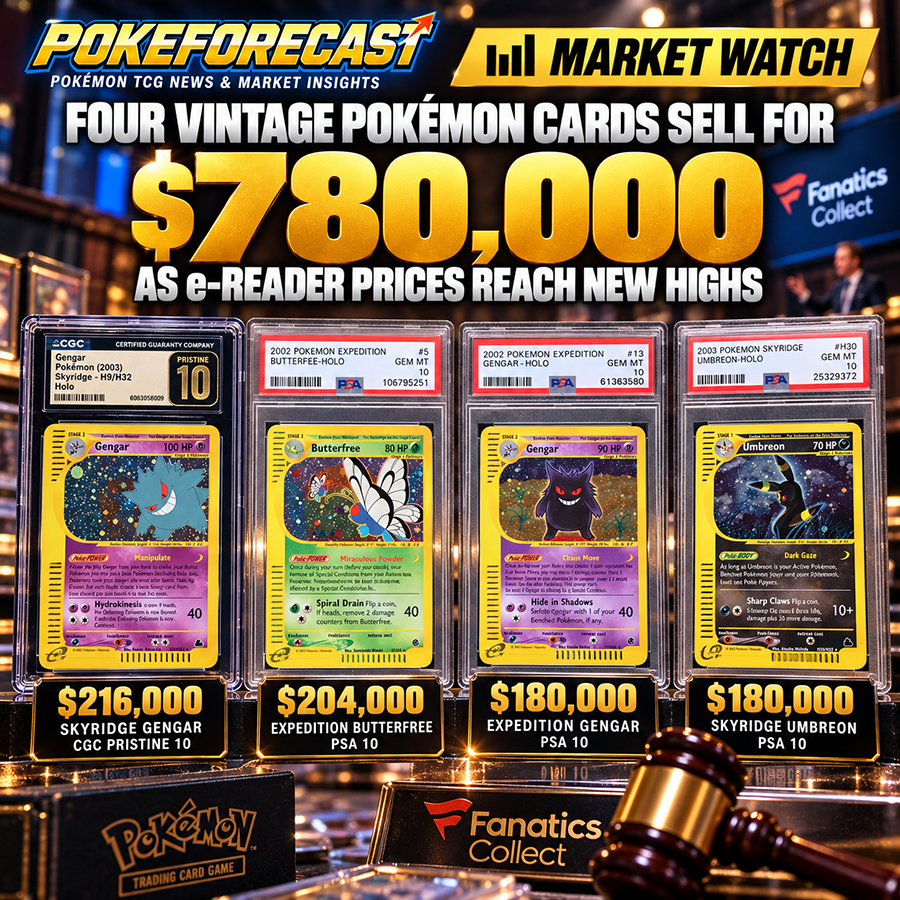
The high-end Pokemon card market has produced another remarkable group of auction results, and this time the attention isn’t centered on Charizard, Pikachu, or another familiar record-breaking collectible. Instead, four cards from the Expedition and Skyridge eras reportedly brought a combined $780,000 at Fanatics Collect’s October 5 auction, including a PSA 10 Expedition Butterfree that reached $204,000.
The Butterfree result stands out because of how quickly prices have changed. An earlier reported sale of $60,001 in August was already a substantial amount for a card that rarely dominates conversations about the most valuable Pokemon collectibles. The latest result is approximately 240% higher, suggesting that competition for exceptional copies of certain e-Reader cards has become considerably more aggressive.
The other reported results were equally striking. A CGC Pristine 10 Skyridge Gengar reached $216,000, while a PSA 10 Expedition Gengar and PSA 10 Skyridge Umbreon each brought $180,000. Together, the four results offer another indication that wealthy collectors are paying extraordinary premiums for some of the most difficult vintage Pokemon cards to obtain in top condition.
However, there is an important distinction between an exceptional auction result and a broader increase in market value. These transactions involve specific cards, grades, and bidders. They tell us something about demand at the very top of the hobby, but they don’t necessarily tell us what an ordinary copy of the same card is worth.
Why Expedition and Skyridge Are Attracting Attention
The Pokemon e-Reader era occupies an interesting place in the history of the trading card game. Expedition Base Set arrived in 2002, followed by Aquapolis and Skyridge, introducing distinctive artwork, unusual card layouts, and the familiar dot-code strips associated with Nintendo’s e-Reader accessory.
For years, these sets attracted dedicated collectors without consistently receiving the same attention as First Edition Base Set or the hobby’s most recognizable promotional cards. That has changed as collectors have become more interested in historically important releases beyond the original Wizards of the Coast sets.
Expedition and Skyridge have several characteristics that appeal to serious collectors. Their artwork is distinctive, their sealed products have become difficult to obtain, and finding certain cards in exceptional condition can be challenging. Skyridge also marked the end of Wizards of the Coast’s involvement with the English-language Pokemon TCG, giving the set additional historical significance.
Those characteristics help explain the interest, but they don’t automatically justify every record price. A card’s population, the number of available examples, its artwork, and the willingness of individual bidders to compete can all influence the outcome of a major auction.
Expedition Butterfree Reaches $204,000
The reported $204,000 sale of Expedition Butterfree is arguably the most interesting result of the group.
Butterfree is a recognizable Pokemon, but it isn’t usually mentioned alongside Charizard, Lugia, or Umbreon when collectors discuss the most expensive cards in the hobby. Seeing an Expedition Butterfree reach six figures illustrates just how much the high-end market can differ from the broader Pokemon collecting market.
The card’s reported PSA 10 population of 19 is central to the story. A low population means relatively few copies have received that grade, and collectors attempting to build complete high-grade sets may have limited opportunities to acquire one.
Still, population figures require context. They can change as additional cards are graded, and a low population doesn’t automatically create strong demand. A card needs interested buyers who are willing and able to compete at those prices.
The reported increase from $60,001 in August to $204,000 in October is particularly dramatic. If both transactions involved comparable PSA 10 examples and were completed under normal auction conditions, the difference points to an unusually aggressive change in bidding.
That doesn’t mean every PSA 10 Butterfree is suddenly guaranteed to sell for $204,000. It means one example reached that level in a particular auction, and the next completed sale will be important in determining whether buyers are willing to support it again.
Gengar and Umbreon Continue to Command Major Premiums
The Gengar and Umbreon results are less surprising in terms of character popularity, although the reported prices are still extraordinary.
Gengar has developed a particularly strong following among collectors, and its distinctive artwork across several vintage sets has made high-grade examples desirable. The reported $216,000 Skyridge Gengar CGC Pristine 10 result and $180,000 Expedition Gengar PSA 10 result reinforce the importance of both character demand and condition.
The difference between CGC Pristine 10 and PSA 10 is also worth considering. They are separate grading standards, and their populations cannot simply be combined or treated as interchangeable. Collectors may assign different premiums depending on the grading company, the card’s appearance, and the scarcity of examples within a particular grade.
Skyridge Umbreon reaching a reported $180,000 fits into another established trend. Umbreon has become one of the most closely followed Pokemon in the modern collecting market, particularly following the popularity of its Evolving Skies alternate artwork. But its appeal extends well beyond modern releases.
The Skyridge card represents an earlier period of Pokemon collecting, and a top-grade example combines character popularity with vintage scarcity. That combination can attract bidders who aren’t necessarily interested in completing an entire set but want a particularly significant Umbreon card.
What makes these results interesting is that three different collector motivations may be operating at the same time: completing high-grade vintage sets, collecting specific Pokemon, and competing for exceptional graded examples.
Are We Seeing a Broader Repricing of Vintage Pokemon Cards?
The bigger question is whether these sales represent a sustained change in the value of high-grade e-Reader cards or another period of unusually aggressive bidding.
We’ve already seen major auction results involving Gold Star cards, LV.X releases, Legendary Collection reverse holos, and other vintage Pokemon collectibles. The latest Expedition and Skyridge transactions appear to fit that wider pattern of attention shifting toward cards with limited top-grade availability.
One possible explanation is that collectors who previously concentrated on the most recognizable trophy cards and early Base Set releases are expanding into other historically important parts of the hobby. Another is that existing e-Reader collectors are competing more aggressively as fewer desirable examples become available.
There may also be an element of momentum. When a card produces an extraordinary auction result, it attracts attention from collectors who previously overlooked that particular set or character. That attention can encourage additional owners to list their cards and bring new bidders into the market.
However, momentum can work in both directions. A small number of exceptional sales can make a market appear stronger than it really is, particularly when there are very few comparable transactions. If the next example sells substantially below the previous record, the earlier result may prove to have been an outlier rather than a reliable new benchmark.
This is why completed sales, repeat transactions, and grading populations matter more than ambitious asking prices.
What This Means for Collectors
For collectors who already own high-grade Expedition, Aquapolis, or Skyridge cards, these auction results provide a reason to reassess the market. They don’t necessarily provide a reason to assume that every card in those sets has increased dramatically.
The strongest premiums appear to be concentrated in exceptional grades and specific cards. A PSA 10 with a population below 20 operates in a very different market from a lightly played raw copy or a PSA 8 with substantially greater availability.
Collectors considering a purchase should also be careful about using a single record sale as their starting point. The most useful comparison is a completed transaction involving the same card, the same grading company, and the same grade. Even then, differences in timing and auction participation can produce significant price variations.
For anyone considering grading an e-Reader card, condition remains critical. Centering, surface wear, scratches, edge damage, and other imperfections can create a substantial difference between a strong-looking raw card and one that actually receives a top grade.
A six-figure PSA 10 result shouldn’t be used to estimate the value of a raw card without carefully considering the likelihood of achieving that grade.
My Read: The High-End Market Is Becoming More Selective, Not Necessarily More Predictable
What interests me most about these sales is the Butterfree result. Gengar and Umbreon have established collector demand, so exceptional prices for their rarest graded cards are easier to understand. Butterfree reaching $204,000 tells us that competition for condition scarcity may be just as important as character popularity in certain corners of the market.
That’s a meaningful development, especially for collectors who have spent years building complete vintage sets in PSA 10.
At the same time, I wouldn’t use these results to declare that the entire e-Reader market has been permanently repriced. Four expensive transactions demonstrate that buyers were willing to compete aggressively for four particular cards. They don’t establish a new price floor across hundreds of different cards and grades.
The next several auctions will tell us more. If comparable Expedition and Skyridge cards continue reaching similar prices, the case for sustained demand becomes stronger. If prices retreat sharply, these sales may ultimately be remembered as an extraordinary moment in a much smaller segment of the hobby.
Either way, the October 5 results deserve attention. They’re another reminder that the most dramatic Pokemon card prices are no longer confined to the handful of collectibles that traditionally dominated the headlines.