
The Pokemon card market is experiencing an unusual divide. While modern chase cards and sealed products have struggled to maintain their prices, rare vintage cards and Japanese promotional releases are attracting extraordinary bids at major auction houses.
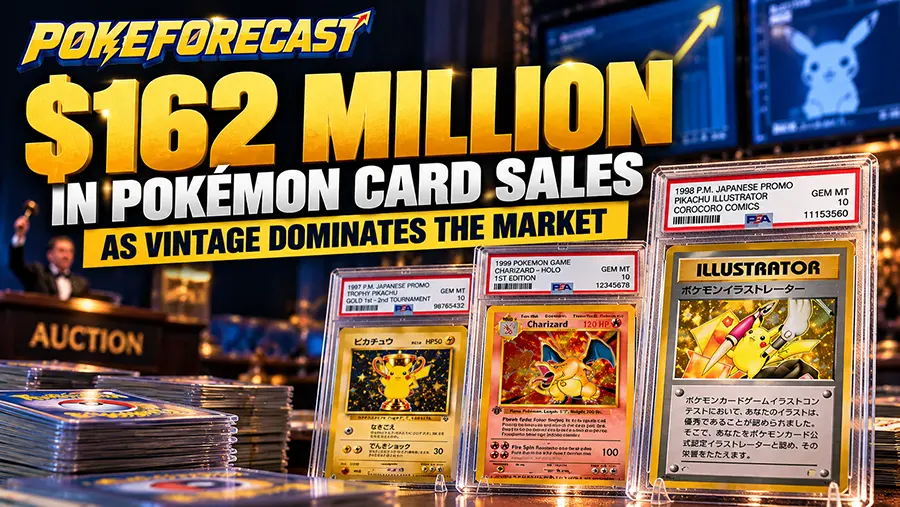
A new market study published October 17 by Pokemon pricing platform UltraBall found that 525 Pokemon card transactions reached at least $100,000 between January 1 and October 16, 2026. Those transactions represented approximately $162.3 million in reported sales across marketplaces including Fanatics Collect, Goldin, Alt, eBay, and Heritage Auctions.
The figures are impressive, but they also come with an important qualification. Not every reported auction result had been paid for when the data was collected, and the study does not include every marketplace or private transaction.
Even with those limitations, the findings provide a revealing look at where some of the largest amounts of money are being spent in the Pokemon card market.
The biggest takeaway isn’t simply that expensive Pokemon cards are getting more expensive. It’s that a relatively small group of rare, high-grade collectibles is attracting enormous sums while much of the modern market faces downward price pressure.
More Than 500 Pokemon Card Sales Exceeded $100,000
UltraBall’s study identified 525 sales of at least $100,000 during the first nine and a half months of 2026, with a combined reported value of $162,319,302.
Of those transactions, 53 reached at least $500,000, while 19 crossed the $1 million threshold. The figures include buyer’s premiums where applicable, meaning they reflect reported final auction prices rather than simply the winning bids.
| Market activity | Reported total |
|---|---|
| Pokemon card sales of $100,000 or more | 525 |
| Combined reported value | $162.3 million |
| Sales of $500,000 or more | 53 |
| Sales of $1 million or more | 19 |
| Sales involving PSA 10 cards | 406 |
| Sales recorded since September 1 | 360 |
The concentration of sales toward the end of the reporting period is particularly interesting. According to UltraBall, 360 of the 525 six-figure transactions occurred between September 1 and October 16, representing approximately $104 million.
However, those numbers shouldn’t be interpreted as proof that high-end Pokemon sales suddenly increased by that amount. UltraBall’s historical coverage varies by marketplace, including the addition of Alt auction data in July.
A more useful comparison comes from Fanatics Collect, where UltraBall has more consistent records beginning in February.
The platform recorded between three and eleven six-figure Pokemon card sales per month from February through July. That increased to 28 in August, 90 in September, and 102 during the first sixteen days of October.
While those figures don’t establish how the entire market is performing, they indicate a substantial increase in high-value auction activity at one major venue.
Japanese Promotional Cards Lead the Biggest Sales
Some of the largest reported transactions involved cards that were never available through ordinary Pokemon booster packs.
UltraBall found that seven of the ten highest-priced sales involved Japanese promotional or prize cards originally distributed through competitions, contests, or special events.
These cards occupy a different part of the collecting market than conventional chase cards. Many were produced in extremely limited quantities, and their ownership histories can become part of their appeal.
The most expensive reported transaction was the PSA 10 Pikachu Illustrator associated with Logan Paul, which sold through Goldin for $16,492,000 in February.
Other notable results included an Art Academy Pikachu at $8.4 million, a PSA 9 Pikachu Illustrator at $5 million, and an Art Academy Mudkip at $3.72 million.
Several conventional set cards also appeared among the largest transactions, including a PSA 10 Gold Star Torchic from Team Rocket Returns, which recorded a $2.7 million auction result in September.
The common factor is scarcity, particularly when combined with exceptional condition and strong collector recognition.
A Japanese promotional card awarded through a limited competition cannot be evaluated in quite the same way as a modern Special Illustration Rare that remains available through booster packs.
Both may be desirable, but their supply characteristics are fundamentally different.
PSA 10 Cards Account for Most Six-Figure Transactions
One of the clearest findings from UltraBall’s report is the importance of professional grading at the highest end of the market.
Of the 525 recorded transactions exceeding $100,000, 406 involved PSA 10 cards. That represents approximately 77% of the total.
A PSA 10 indicates that a card received PSA’s Gem Mint grade, but the financial premium attached to that grade can vary dramatically depending on the card.
For some modern Pokemon cards, the difference between a PSA 9 and PSA 10 may be relatively modest. For scarce vintage cards, particularly those released when collectors were less focused on preserving cards in pristine condition, the difference can be enormous.
The report also highlights which eras are attracting the largest transactions.
Of the 525 six-figure sales, 169 involved Wizards of the Coast-era cards released between 1999 and 2003, while another 101 came from the EX era between 2003 and 2007.
Only twelve involved cards printed since 2014.
That distinction is important because it demonstrates how heavily the highest-value market remains concentrated in older releases, despite the enormous popularity of modern Pokemon cards.
Modern cards may generate considerable trading activity and attract large numbers of collectors, but the most expensive individual transactions continue to be dominated by older cards and exceptionally scarce promotional releases.
Modern Pokemon Cards Are Moving in the Opposite Direction
The strength of the high-end auction market becomes more interesting when compared with recent Pokemon card pricing trends.
According to PokeForecast’s Pokemon Market Data, the 30-day period ending October 11 showed a substantial difference between vintage and modern card performance.
Vintage cards released between 1999 and 2007 increased 12.1%, while cards from the 2008 through 2019 period gained 5.2%. Modern cards released from 2020 onward declined 7.2%.
| Pokemon card segment | 30-day change |
|---|---|
| Vintage (1999–2007) | +12.1% |
| Mid-era (2008–2019) | +5.2% |
| Modern (2020–present) | -7.2% |
These figures measure qualifying Near Mint card prices tracked by PokeForecast, rather than high-end graded auction transactions.
The two datasets therefore describe different parts of the market and shouldn’t be treated as directly comparable measures of performance.
However, they point toward an interesting distinction. Older Pokemon cards have recently shown stronger pricing performance, while many modern singles have experienced declines despite continued collector interest.
TCGplayer’s October market analysis also identified falling prices across several recognizable modern chase cards, including Umbreon ex, Pikachu ex, and Umbreon VMAX.
This doesn’t necessarily mean collectors are abandoning modern releases. New products continue generating substantial sales activity, and popular chase cards remain valuable even after experiencing price corrections.
What appears to be changing is how much collectors are willing to pay for cards that may become more widely available as additional products are opened.
The highest-end vintage market faces a different supply situation, particularly for cards with very small populations in exceptional condition.
Why Rare Vintage Cards Continue Attracting Large Buyers
The appeal of vintage Pokemon cards extends beyond nostalgia.
Older cards have established supply histories, and many of the rarest promotional releases were never widely distributed. In some cases, only a small number of copies are known to exist.
Even when a card was printed in relatively large quantities, finding one in exceptional condition decades later can be difficult.
That distinction matters because collectors purchasing a PSA 10 vintage card may be competing for a much smaller pool of available examples than buyers of an ordinary ungraded copy.
The strongest auction results also tend to involve cards with recognizable histories, desirable artwork, or established importance within the hobby.
Pikachu Illustrator is a good example. Its connection to early Japanese illustration contests gives it a collecting history that cannot be replicated by simply releasing another Pikachu card.
Similarly, early trophy cards and rare Japanese promotional releases often appeal to collectors interested in the history of the Pokemon Trading Card Game rather than just the characters depicted.
However, scarcity alone does not guarantee appreciation. A card also needs buyers willing to pay a premium, and that demand can change over time.
Some rare cards trade so infrequently that a single auction can dramatically alter their apparent market value. That makes individual record prices useful reference points, but not necessarily reliable estimates of what another copy would sell for.
Not Every Million-Dollar Auction Result Is a Completed Sale
There is an important limitation in UltraBall’s findings that collectors should understand before interpreting the $162.3 million total.
The company identified 37 auction results at Alt, representing approximately $11.7 million, that were still awaiting payment when the data was collected.
Those transactions were included in the study’s reported totals even though payment had not been confirmed.
Among the affected results were a PSA 10 First Edition Typhlosion at approximately $1.55 million, a Tamamushi University Magikarp at $1.056 million, and a Gold Star Mudkip at $1.046 million.
An auction ending with a winning bid does not necessarily mean the transaction has been completed.
If the winning bidder fails to pay, the card may eventually return to auction or be offered to another buyer. Until that process is resolved, the original result should not automatically be treated as a verified sale.
This distinction has become increasingly relevant as Pokemon auction prices reach levels previously associated with major fine-art and collectible markets.
Pricing platforms, collectors, and auction houses frequently use historical transactions to estimate current values. When unpaid auction results are included without qualification, those estimates can become misleading.
The issue is particularly significant for rare Pokemon cards because there may be very few comparable transactions available.
UltraBall also acknowledges that its dataset does not include Japanese marketplaces or private sales, and that historical coverage differs among the platforms it tracks.
The study provides a useful picture of publicly reported high-value activity, but it is not a complete accounting of every expensive Pokemon card sold during 2026.
Is the Pokemon Market Becoming Two Separate Markets?
The growing difference between ordinary modern cards and high-end vintage collectibles raises an interesting question about how the Pokemon market should be evaluated.
A collector purchasing a modern chase card for a few hundred dollars is participating in a very different market from someone bidding millions on a rare Japanese promotional card.
Modern card prices are influenced by new releases, additional product distribution, collector trends, and the number of copies entering circulation.
At the highest end of the market, prices can be influenced by a small group of wealthy collectors competing for cards that rarely become available.
These markets are connected through the broader Pokemon collecting hobby, but they do not necessarily respond to the same conditions.
A decline in modern card prices does not automatically mean demand for rare vintage cards will increase. Likewise, a record auction result does not establish that the entire Pokemon card market is appreciating.
There is also no clear evidence from these reports that collectors are directly moving money out of modern cards and into vintage collectibles.
The available data shows different pricing and transaction patterns, but it does not establish the motivations or purchasing decisions of individual buyers.
For collectors trying to understand the market, that distinction is becoming increasingly important.
My Read: Record Auctions Are Only Part of the Story
The $162.3 million figure is impressive, but I think the more meaningful finding is how concentrated the highest-value Pokemon transactions have become.
More than three-quarters of the reported six-figure sales involved PSA 10 cards, and the overwhelming majority came from older releases rather than modern sets.
That tells us something about what collectors are paying the largest premiums for, but it doesn’t mean every vintage card is becoming more valuable or that modern Pokemon collecting is losing its appeal.
The current market appears increasingly selective. Collectors are still willing to spend extraordinary amounts on cards with established scarcity, exceptional condition, and historical importance. At the same time, modern cards remain vulnerable to price corrections when supply increases or early demand begins to settle.
I would also be careful about treating every million-dollar auction as proof of a new market value. With approximately $11.7 million in reported results still awaiting payment when UltraBall collected its data, the distinction between a winning bid and a completed transaction matters.
For ordinary collectors, the lesson isn’t that vintage cards are automatically better purchases. It’s that Pokemon card values depend on much more than popularity, recent headlines, or the highest price someone has offered at auction.
Condition, supply, transaction history, and the number of serious buyers all matter.
PokeForecast will continue tracking these differences through its Pokemon Market Data dashboard, where collectors can compare pricing trends across vintage, mid-era, and modern cards.
The next question is whether the recent strength in older cards can continue while modern prices remain under pressure, or whether the extraordinary auction activity will eventually begin to cool as well.
Editorial note: The $162.3 million represents reported auction and marketplace results, not exclusively verified paid transactions. I’ve made that distinction throughout the article rather than presenting the entire amount as confirmed spending.