
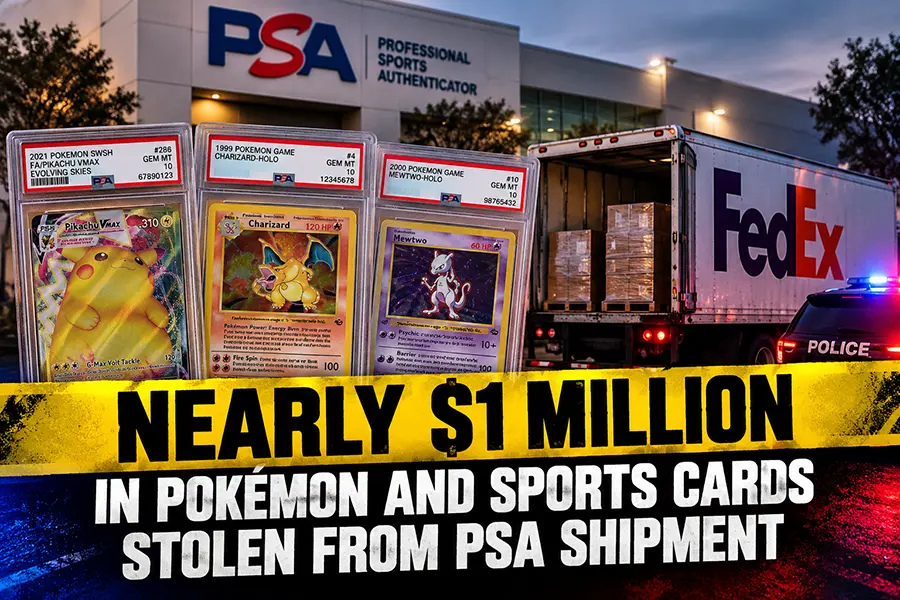
Nearly $1 million worth of graded trading cards, including Pokemon cards, were stolen from a FedEx truck outside PSA’s California grading facility, leaving collectors without their cards and raising serious questions about shipping security and insurance coverage.
The theft occurred October 13, 2026, near Professional Sports Authenticator’s headquarters in Santa Ana, California. According to police, thieves broke into a FedEx truck carrying hundreds of packages containing recently graded trading cards that were being returned to their owners.
The initial estimated loss was $963,000, although that figure could increase as investigators determine the contents of additional missing packages. The shipment included Pokemon cards, sports cards, and other collectibles, meaning the reported value does not represent Pokemon cards alone.
PSA has confirmed the incident and says it is working with FedEx and law enforcement. The grading company has also deactivated certification numbers associated with the stolen cards and notified major marketplaces to help prevent them from being resold.
For collectors who trusted PSA to grade and return their valuable cards, the incident has created another concern beyond the theft itself: whether insurance will cover the full value of cards that may have appreciated significantly after grading.
How the PSA Card Theft Happened
According to the Santa Ana Police Department, the theft occurred near PSA’s shipping and receiving facility on East St. Andrew Place.
The FedEx driver reportedly left the truck unattended for approximately 60 to 90 minutes. During that period, thieves broke the vehicle’s lock and removed packages containing graded trading cards.
Investigators say two pallets, each holding approximately 100 packages, were stolen. Around 50 additional packages were reportedly taken from a third pallet.
That puts the estimated number of affected packages at approximately 250, although the total number of individual cards remains unknown. A single package could contain multiple graded cards, making the eventual number of missing collectibles considerably higher.
The initial $963,000 valuation covered the two pallets identified in the original report. The value of additional missing packages was still being determined as of October 20.
Police have not announced any arrests or recoveries, and investigators have not established whether the thieves specifically targeted PSA shipments or knew the value of the packages inside the truck.
The incident occurred after the cards had already been graded and were being transported back to customers. That distinction is important because the affected collectors had completed the authentication process and were expecting to receive their newly graded cards.
PSA Deactivates Certification Numbers on Stolen Cards
PSA has taken several steps intended to make the stolen cards more difficult to sell.
The company confirmed that it deactivated the certification numbers associated with the affected items and contacted marketplace partners, including auction platforms and other businesses involved in trading valuable collectibles.
Every PSA-graded card receives a unique certification number that can be checked through the company’s online database. These numbers are associated with the card’s identity and assigned grade, providing buyers with a way to review its certification information.
By deactivating the stolen certificates, PSA is attempting to create a warning for buyers and marketplaces that encounter the missing cards.
However, the system has limitations.
A deactivated certification number may help identify a stolen card while it remains inside its original PSA holder. If someone removes the card from that holder, the connection to its certification number becomes more difficult to establish.
Some rare Pokemon cards have distinctive characteristics that may help identify them, including unique serial numbers or documented physical features. Most ordinary trading cards do not have individual identifiers printed directly on them.
That means certification deactivation can make resale more difficult, but it cannot guarantee that every stolen card will be identified or recovered.
Collectors purchasing expensive graded cards should continue checking certification numbers through PSA’s official verification database, particularly when dealing with unfamiliar sellers.
A valid certification number alone is not proof that a card or holder is genuine, but an invalid or deactivated number is a reason to investigate further before purchasing.
One Collector Reports Losing 104 Graded Cards
Among the collectors affected is trading card content creator SKY-B, who reported losing a submission containing 104 cards accumulated over approximately two years.
According to his public account, the submission included valuable sports cards that had already completed the grading process and were being returned to him.
SKY-B said he spent approximately $8,468 on grading fees and had insured the submission for up to $156,000.
However, he believes the cards may have been worth more than the insured amount after grading, creating the possibility that financial compensation will not fully cover their current market value.
His situation illustrates a problem that applies to Pokemon collectors as well.
A raw Pokemon card might be submitted with an estimated value based on its condition before grading. If PSA subsequently awards a PSA 10, the card’s market value could increase substantially, particularly for rare vintage cards or valuable modern chase cards.
In some cases, the difference between a PSA 9 and PSA 10 can amount to thousands of dollars.
If the declared insurance value was established before grading, collectors could find themselves holding coverage that no longer reflects the value of their cards.
There is also the problem of replacing rare collectibles. Even when a card’s market value can be established, finding another copy with the same grade, appearance, and condition may not be straightforward.
For cards with extremely small grading populations, replacement may be difficult regardless of the amount of compensation offered.
Will PSA Reimburse Collectors for Their Missing Cards?
PSA says it has contacted affected customers directly and is arranging compensation based on fair market value.
However, the company’s reimbursement policy includes an important limitation: compensation is subject to the maximum insured value selected for each item before grading.
This means a collector whose card increased significantly in value after receiving a high grade may not necessarily receive the full amount that an equivalent graded copy would sell for today.
For example, consider a hypothetical Pokemon card submitted with an insured value of $1,000. If the card receives a PSA 10 and comparable graded copies sell for $4,000, the original insurance limit could prevent the owner from recovering the full $4,000.
That example is illustrative, not a confirmed payout from the current theft.
The actual reimbursement amount will depend on the circumstances of each submission, the applicable insurance limits, and PSA’s assessment of fair market value.
Collectors may also face challenges establishing a reliable market value for cards with few recent sales. Rare promotional Pokemon cards, low-population vintage cards, and unusual grading results can have widely varying transaction prices.
This is especially relevant in a market where exceptional auction results do not always provide a dependable benchmark for the next sale.
PSA has indicated that affected grading fees will be refunded, but that does not eliminate the possibility of losses associated with increased card values or the difficulty of replacing rare collectibles.
What the Theft Means for Pokemon Card Collectors
The incident highlights an often overlooked part of Pokemon card collecting: the risks involved in transporting valuable cards to and from grading companies.
Much of the discussion surrounding professional grading focuses on authentication, condition, and whether the potential increase in value justifies the grading fee.
Shipping security receives less attention, even though collectors may be sending cards worth hundreds, thousands, or occasionally tens of thousands of dollars through commercial delivery services.
Once those cards leave the collector’s possession, their safety depends on several different parties, including the grading company, shipping carrier, and any facilities involved in handling the packages.
The current theft occurred during the return shipment, after PSA had completed its work.
For collectors considering submitting valuable Pokemon cards, the incident reinforces the importance of understanding the insurance terms before sending anything.
There are several precautions worth considering:
- Review declared values carefully. Understand the maximum compensation available if a card is lost or stolen, particularly if a high grade could substantially increase its value.
- Document cards before submission. Keep photographs, purchase records, submission details, and identifying information that may help establish ownership and value.
- Check return shipping options. Review available insurance and delivery services, especially for submissions containing high-value cards.
- Keep certification records. Once grades become available, save the certification numbers and card details in case a shipment goes missing.
- Use reputable sellers when buying graded cards. Verify certification information and be cautious of unusually inexpensive listings involving valuable collectibles.
None of these steps can completely eliminate shipping risks, but they can help collectors understand their exposure and provide documentation if something goes wrong.
Could Stolen Pokemon Cards Reappear on the Market?
One concern following a theft of this size is whether the missing cards will eventually appear for sale through online marketplaces, auction houses, or private transactions.
PSA’s decision to notify marketplace partners is intended to reduce that possibility.
Major auction houses and established card marketplaces often have procedures for reviewing suspicious inventory, particularly when high-value collectibles have been reported stolen.
However, the trading card market also includes private sales, informal transactions, and sellers operating outside major platforms.
A stolen card removed from its PSA holder could potentially be offered as an ungraded card, making it more difficult to connect with the original certification record.
This is why the list of affected certification numbers could become important to collectors and businesses attempting to identify missing cards.
Collector Nick Andrews, known online as Boston Card Hunter, has reportedly been compiling information about cards affected by the theft to assist with identification and possible recovery.
As of October 20, the full inventory of missing cards had not been publicly established.
Buyers should avoid assuming that an expensive Pokemon card is suspicious simply because it appears for sale following the incident. Any concerns should be based on specific identifying information, certification records, or credible evidence connecting a card to the stolen shipment.
My Read: The Insurance Question May Be Bigger Than the Theft
The nearly $1 million valuation makes this one of the more significant recent thefts involving professionally graded trading cards, but I think the longer-term issue is what happens to collectors when a card disappears after grading.
The entire purpose of sending a valuable Pokemon card to PSA is to establish its authenticity and condition. In many cases, the resulting grade can dramatically change how the market values that card.
That creates a difficult situation when insurance coverage is based on a value established before the final grade is known.
A collector who submits a rare card and receives an exceptional grade may suddenly own something worth considerably more than originally expected. If that card disappears during its return shipment, the owner may discover that the available compensation does not reflect the new market value.
There is also a difference between financial value and collectibility. A rare Pokemon card that took years to acquire cannot always be replaced simply by receiving a payment based on recent sales.
PSA deserves credit for moving to deactivate certification numbers and alert marketplaces, but those measures primarily address what happens after the theft. They do not resolve questions about shipping security or whether collectors are adequately protected while their cards are in transit.
The investigation is still ongoing, and there is no evidence that the theft involved wrongdoing by PSA employees. The reported burglary occurred in a third-party shipping vehicle, and authorities have not identified the suspects.
Nevertheless, collectors are entitled to expect that valuable submissions will be handled with appropriate security throughout the grading and return process.
For Pokemon collectors, this incident is a reminder that grading is not just about the possibility of increasing a card’s value. It also involves trusting several companies to protect an item that may be difficult, expensive, or impossible to replace.