
The Pokemon card market has spent much of 2026 making headlines for record-breaking sales. Gold Stars, Legendary Collection Reverse Holos, LV.X cards and rare promotional cards have all attracted extraordinary prices, with some PSA 10 examples selling for several times what comparable copies brought only months earlier.
But September’s auction data from Goldin tells a somewhat different story.
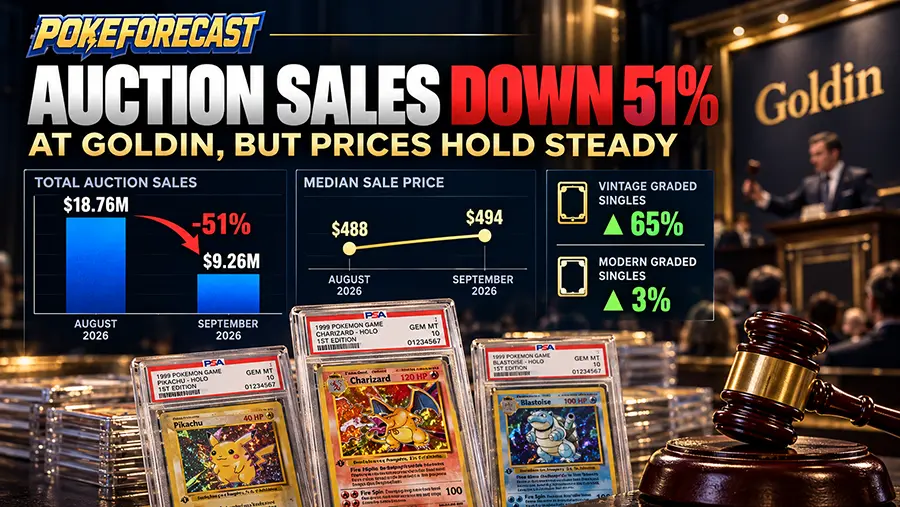
According to a Pokemon auction market report published October 10, total Pokemon sales at Goldin declined from $18.76 million in August to $9.26 million in September, a decrease of approximately 51%. The number of lots sold also fell sharply, dropping from 2,450 to 1,265 during the same period.
At first glance, those numbers might suggest that the market is beginning to cool after an unusually strong summer. However, looking beyond the total sales figures reveals something considerably more interesting. While fewer cards were changing hands, the median selling price actually increased slightly.
That distinction matters because a decline in auction activity is not necessarily the same thing as a decline in Pokemon card values.
Goldin’s September Numbers Show a Sharp Decline in Activity
The most noticeable change in September was the reduction in the amount of Pokemon material moving through Goldin’s auctions.
August generated $18.76 million in reported sales across 2,450 lots. September produced $9.26 million across 1,265 lots. That represents approximately half the sales volume and roughly half the number of transactions from the previous month.
Those are substantial month-to-month declines, particularly given the attention that high-end Pokemon cards have received throughout 2026.
However, the average value of the cards being offered is just as important as the number of cards being sold. Auction houses don’t necessarily offer the same quantity or quality of material every month, and a handful of exceptionally expensive cards can dramatically influence total sales figures.
For example, an auction containing several million-dollar Pokemon cards can generate enormous revenue even if the overall number of lots is relatively small. The following month might feature fewer trophy cards and produce substantially less revenue without indicating that collectors have suddenly stopped buying.
That is one of the challenges with interpreting auction data, especially at the high end of the Pokemon market.
A 51% decline in total sales is significant, but it doesn’t tell us whether individual cards have become less valuable.
Median Prices Actually Increased in September
One of the more interesting findings in the report is that Goldin’s median Pokemon sale price increased from $488 in August to $494 in September.
That is a relatively small change of approximately 1.2%, but it is important when viewed alongside the much larger decline in total auction sales.
The median represents the middle transaction when sales are arranged from lowest to highest. Unlike the average, it is less affected by a handful of extremely expensive cards.
In other words, even though Goldin sold far fewer Pokemon lots in September, the middle transaction did not become cheaper.
That doesn’t prove the market was strengthening, since the mix of cards offered may have changed between the two months. If September contained a greater proportion of valuable graded cards and fewer inexpensive items, the median could increase even if prices for individual cards remained unchanged.
Still, it makes the overall picture considerably more complicated than the headline sales decline suggests.
If Pokemon card values were collapsing across the board, we would expect to see broader evidence of weakening prices in comparable cards. The Goldin figures alone do not establish that.
Vintage PSA Cards Continue to Show Strength
The report also points to a notable difference between vintage and modern graded Pokemon cards.
Median sale prices for vintage graded singles reportedly increased 65% in September, while modern graded singles recorded a more modest 3% increase.
That is an interesting development considering what we’ve been seeing throughout the high-end Pokemon market this year.
Vintage cards in exceptional condition have been attracting increasingly aggressive bids, particularly when PSA 10 populations are low. Legendary Collection Reverse Holos, Gold Stars and other difficult-to-grade cards have produced some of the most dramatic results.
There is a reason collectors pay such enormous premiums for certain vintage PSA 10s.
Unlike modern cards, many older Pokemon cards were opened, handled and stored long before professional grading became as widespread as it is today. Finding a genuinely pristine copy can be extremely difficult, and in some cases the PSA population has barely changed despite years of rising prices.
That creates a supply problem when multiple collectors begin competing for the same card.
However, the reported 65% increase in vintage median prices should not automatically be interpreted as a 65% appreciation in vintage Pokemon cards. It measures the median price of the vintage cards sold during those auction periods, not necessarily the price changes of identical cards.
If Goldin offered more valuable vintage cards in September, that alone could help explain the increase.
The figures are still useful because they show that vintage graded cards remained an important part of auction activity, even during a month when total sales declined sharply.
The Million Dollar Sales Are Only Part of the Market
One of the biggest mistakes collectors can make when following the Pokemon market is assuming that record auction prices reflect what is happening everywhere else.
We’ve recently seen extraordinary results involving Art Academy promotional cards, Gold Stars and low pop PSA 10s. The $8.4 million Art Academy Fujishima Pikachu auction result at Fanatics Collect is perhaps the most extreme example.
Those transactions attract attention because the numbers are enormous, but they represent a very small portion of the overall Pokemon market.
Most collectors are not purchasing six figure cards. They’re buying modern singles, completing sets, opening booster boxes or collecting graded cards that sell for a few hundred dollars.
Those markets operate differently.
A collector spending $200 on a modern PSA 10 is generally comparing several available copies, recent completed sales and current marketplace listings. Someone bidding on a rare Art Academy promotional card may be competing for an opportunity that doesn’t come around very often.
That difference can produce two very different markets at the same time.
We could see record prices for the rarest PSA 10 cards while more ordinary graded cards remain flat or decline. We could also see reduced auction activity without a corresponding drop in prices for the cards collectors are still actively purchasing.
September’s Goldin data is another reminder that there isn’t one single Pokemon card market moving in one direction.
Are Collectors Becoming More Selective?
One possible interpretation of September’s results is that the market is becoming more selective after a particularly active summer.
The number of lots sold declined substantially, but the median sale price remained relatively stable. That combination raises the possibility that buyers are still willing to spend money on desirable cards, even as overall auction activity slows.
However, we need to be careful about drawing conclusions regarding collector behavior from one auction house.
A decline in lots sold does not necessarily mean fewer collectors wanted to buy cards. It could simply mean Goldin offered fewer lots or scheduled fewer major Pokemon auctions during September.
Likewise, a stable median doesn’t tell us whether the same buyers are participating or whether demand has shifted toward different types of cards.
To establish that collectors are becoming more selective, I would want to see additional evidence from completed sales across multiple marketplaces, including transaction counts, sell-through rates and prices for comparable cards.
TCGplayer and eBay are particularly important here because they capture a much broader range of everyday Pokemon transactions than a premium auction house.
For now, selectivity is a possible explanation, not something the September figures conclusively demonstrate.
Why One Auction House Cannot Define the Entire Pokemon Market
Goldin is an important venue for high-value Pokemon cards, but its monthly results represent only one part of the market.
Fanatics Collect, Heritage Auctions, eBay and other marketplaces also handle significant Pokemon transactions. TCGplayer provides another perspective through its much broader singles market, particularly for modern English cards.
Each platform attracts a somewhat different mix of sellers, buyers and products.
A month with fewer major Goldin consignments could coincide with exceptionally strong results at Fanatics or Heritage. Similarly, an expensive vintage card selling at auction doesn’t necessarily tell us anything about demand for sealed modern products.
That is why I wouldn’t interpret Goldin’s 51% sales decline as evidence that the entire Pokemon market lost half its value or that collector demand has suddenly collapsed.
Neither conclusion is supported by the data.
What we have is evidence that one major auction venue experienced a substantial month-to-month decline in reported Pokemon sales activity, while its median transaction price remained relatively stable.
That is meaningful information, but it is not a complete picture.
What I’m Watching Next
The next few months should give us a better indication of whether September was simply a quieter auction period or the beginning of a broader change.
The first thing I want to see is whether October’s auction activity rebounds. If Goldin returns to August’s sales levels, September may ultimately look more like a temporary decline influenced by auction scheduling and available inventory.
If sales activity remains lower for several consecutive months, the possibility of a more sustained slowdown becomes worth investigating.
I would also pay close attention to repeat sales of specific vintage PSA 10 cards. Comparing the same card in the same grade across different dates tells us considerably more about actual price appreciation than comparing the median values of two different groups of cards.
The same applies to modern graded singles. A 3% increase in the median transaction price is interesting, but it doesn’t necessarily mean modern PSA 10 prices increased by 3%.
Finally, sealed Pokemon products deserve separate attention. The 30th Celebration release has created enormous demand, but sealed product prices depend on factors such as available inventory, future restocks and collector expectations that don’t always move alongside graded-card auctions.
Looking at all three areas together should give us a much clearer understanding of where the market is heading.
My Read
I don’t think September’s Goldin numbers are evidence of a Pokemon market crash.
A 51% decline in monthly auction sales is certainly worth paying attention to, particularly after the extraordinary prices we’ve seen throughout 2026. But the fact that median selling prices remained relatively stable suggests the story is more complicated than a simple collapse in demand.
What interests me most is the growing separation between activity and price.
We’ve spent much of this year watching low-population PSA 10 cards establish extraordinary auction records. That has created an impression that the entire high-end Pokemon market is accelerating without interruption.
Goldin’s September figures offer a useful counterpoint. Even during a year filled with record sales, overall auction activity can decline sharply from one month to the next.
That doesn’t necessarily mean collectors are abandoning the market, just as a million-dollar sale doesn’t mean every rare Pokemon card is suddenly worth twice as much.
I still believe genuinely scarce, desirable Pokemon cards in exceptional condition are among the most interesting areas of the market to follow. But I also think collectors need to distinguish between isolated record sales, changes in auction volume and actual price appreciation.
Those are three different things, and treating them as interchangeable can create a misleading picture of what is happening.
For now, September looks like a quieter month at Goldin rather than evidence of a broad Pokemon market downturn. Whether that changes in October and November will depend on what happens to transaction volume, repeat-sale prices and demand across the other major marketplaces.
The next few months should tell us whether the market is simply taking a break from an extraordinary summer or beginning to move into a different phase.